My first quantum neuron was designed. I knew how a spiking neuron should behave, and I chose quantum gates that would behave that way. It works, but nothing in physics says it had to look like that. This paper, written with Domenica Dibenedetto and Francesco Petruccione, takes the other road. It starts from the electrical circuit of a neuron and applies quantum mechanics to it by the standard rules, to find the quantum neuron the circuit itself implies.
Why derive one
Models of neurons run from the very simple to the very detailed. At one end is the artificial neuron of deep learning, which is a weighted sum. At the other is the Hodgkin-Huxley model, which follows the ion channels of a real nerve cell. Both ends have been given quantum versions. The leaky integrate-and-fire neuron sits between them. It is close enough to biology to be useful and cheap enough to compute, and it is what most neuromorphic hardware is built on. It had not been formally quantised.
A derived model matters because other work can be built on it. A designed model tells you that something can be done. A derived one tells you what the physics allows, and what it costs.
A resistor that remembers
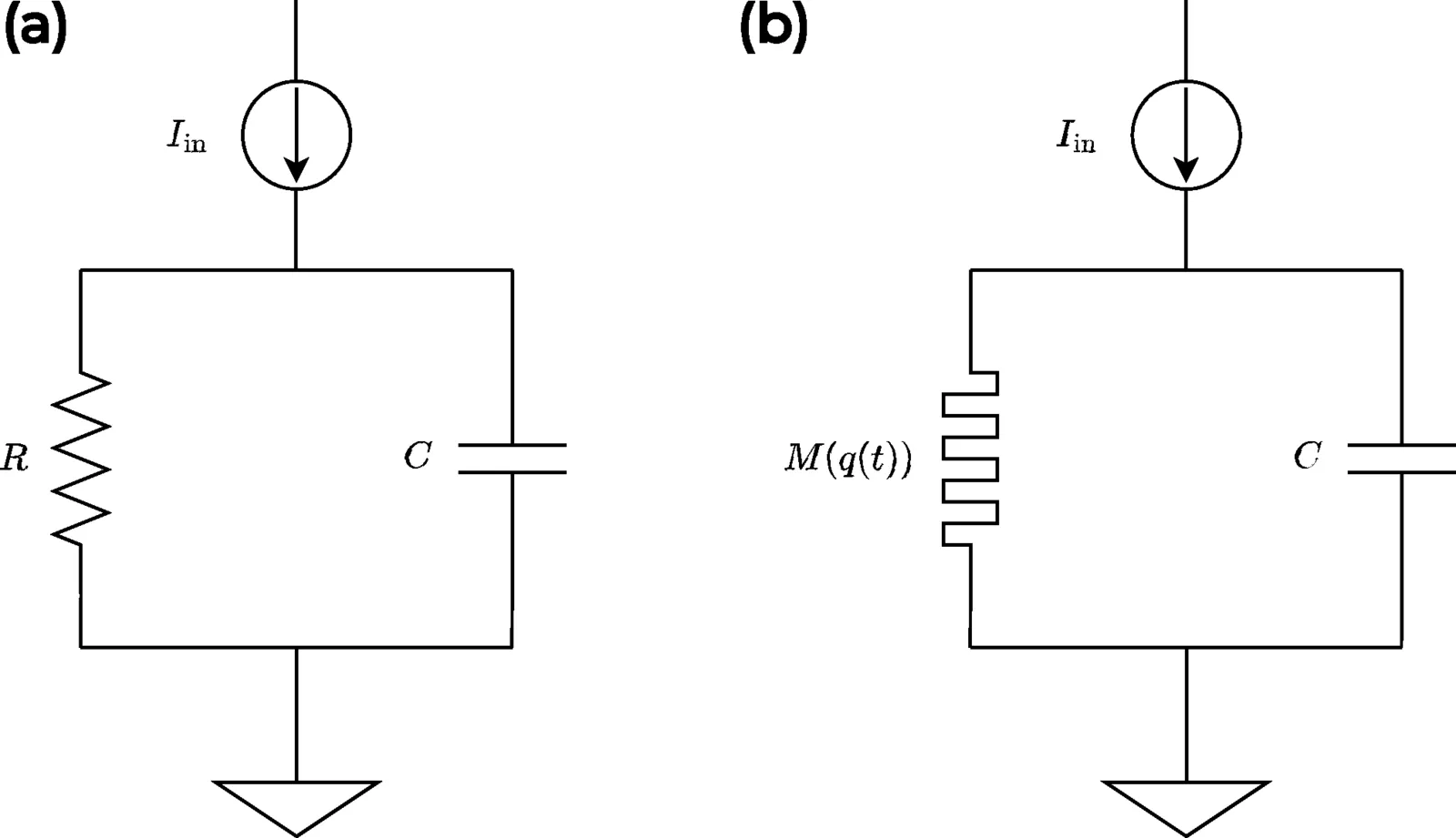
The classical neuron is a capacitor and a resistor. Current charges the capacitor, which is the neuron integrating its input. The resistor drains it, which is the leak. When the voltage crosses a threshold, the neuron fires and resets.
We change one part. In place of the resistor we put a memristor, a component proposed by Leon Chua in 1971 and first built in 2008. A memristor is a resistor whose resistance depends on how much charge has already passed through it. It remembers. With a memristor as its leak, the neuron leaks faster or slower depending on its own past, so it adapts to what it has seen. Synapses and ion channels in a real brain do something similar.
The trouble with resistance
Here is the difficulty. Quantum mechanics, in its basic form, describes systems that keep their energy and can run backwards. A resistor does neither: it turns energy into heat and the heat does not come back. There is no way to write a resistor, or a memristor, straight into the equations.
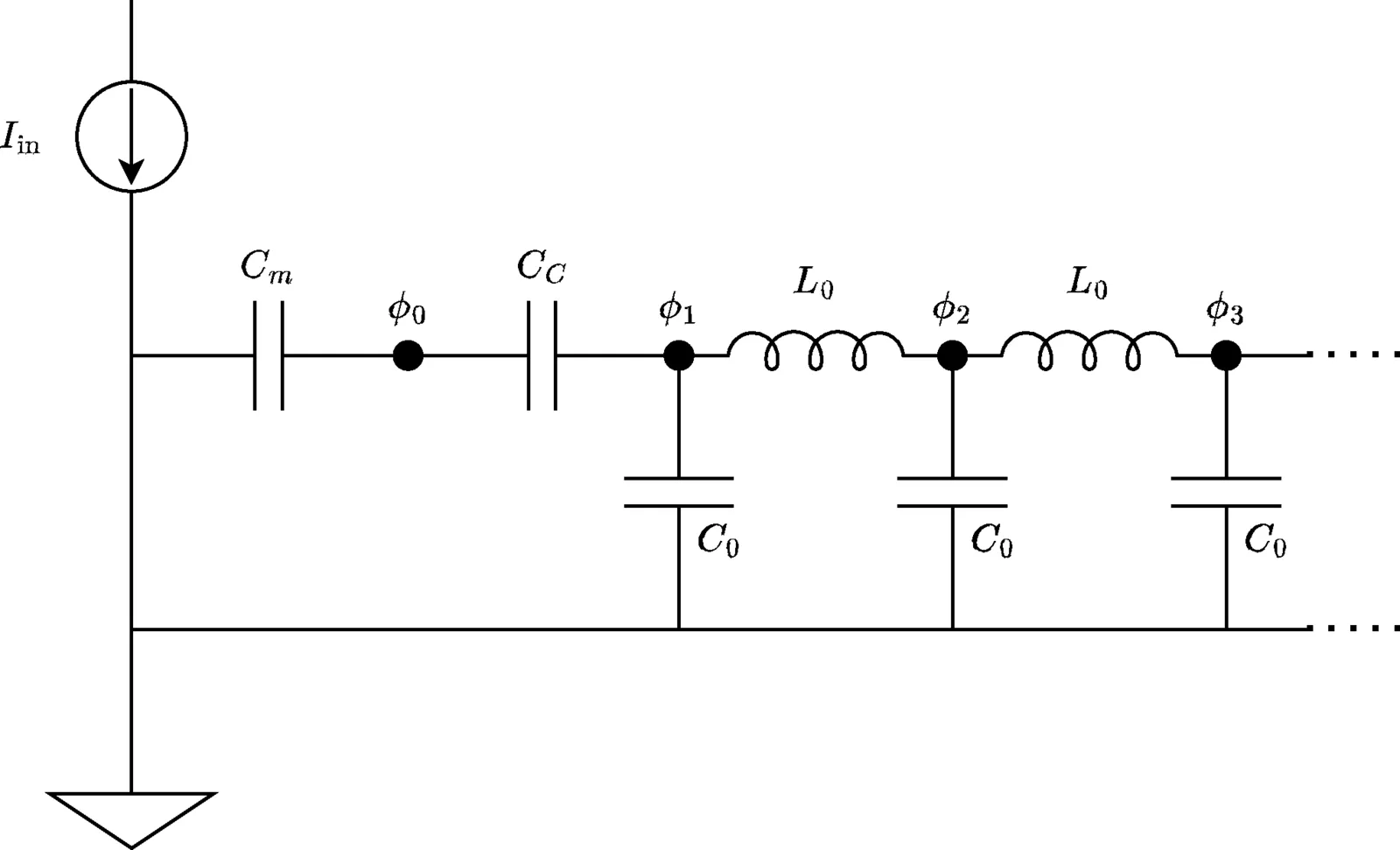
The way round this is an old one, due to Caldeira and Leggett. Replace the resistor with a transmission line: a chain of inductors and capacitors that goes on for ever. The line itself loses nothing. But energy that enters it travels away down the chain and never returns, so from the neuron’s side it looks exactly like a resistor. Its resistance is set by the line’s characteristic impedance, Z0.
To make the line a memristor, we let Z0 change slowly, following the charge that has flowed. The neuron is joined to the line through a small capacitor, so that the line disturbs it only a little. That is the circuit at the top of this page.
From there the route is the textbook one. Write down the energy of the whole circuit as a Lagrangian. Find the momentum that goes with each coordinate. Build the Hamiltonian. Then promote the membrane’s flux and charge to quantum operators that do not commute. The result is a full quantum description of the neuron and its memristive leak together.
Does it still remember?
A memristor has a signature. Drive it with an alternating current and plot current against voltage, and the curve is a loop pinched at the origin, like a figure of eight. A plain resistor gives a straight line. Leon Chua’s test is blunt: if it is pinched, it is a memristor.
So we simulated the quantum circuit under an alternating drive, tracking its state over 2 000 time steps and updating the memristance at each one, and plotted the average current against the average voltage.
Classical memristor
Quantised circuit
The quantum loop is pinched, so the circuit has a memory. It is not a copy of the classical loop. It is less smooth, which comes from the approximations made in the weak-coupling limit and from quantum fluctuations. Its voltage is about a thousand times smaller, which comes from the losses into the line. The shape that defines a memristor survives both.
Does it still spike?
A memristor with a capacitor is not yet a neuron. It also has to fire. In the simulation we watch the average voltage. When it crosses the threshold we record a spike and put the circuit back into its lowest-energy state. Then we hold it still for a short refractory period, as a real neuron is held after it fires.
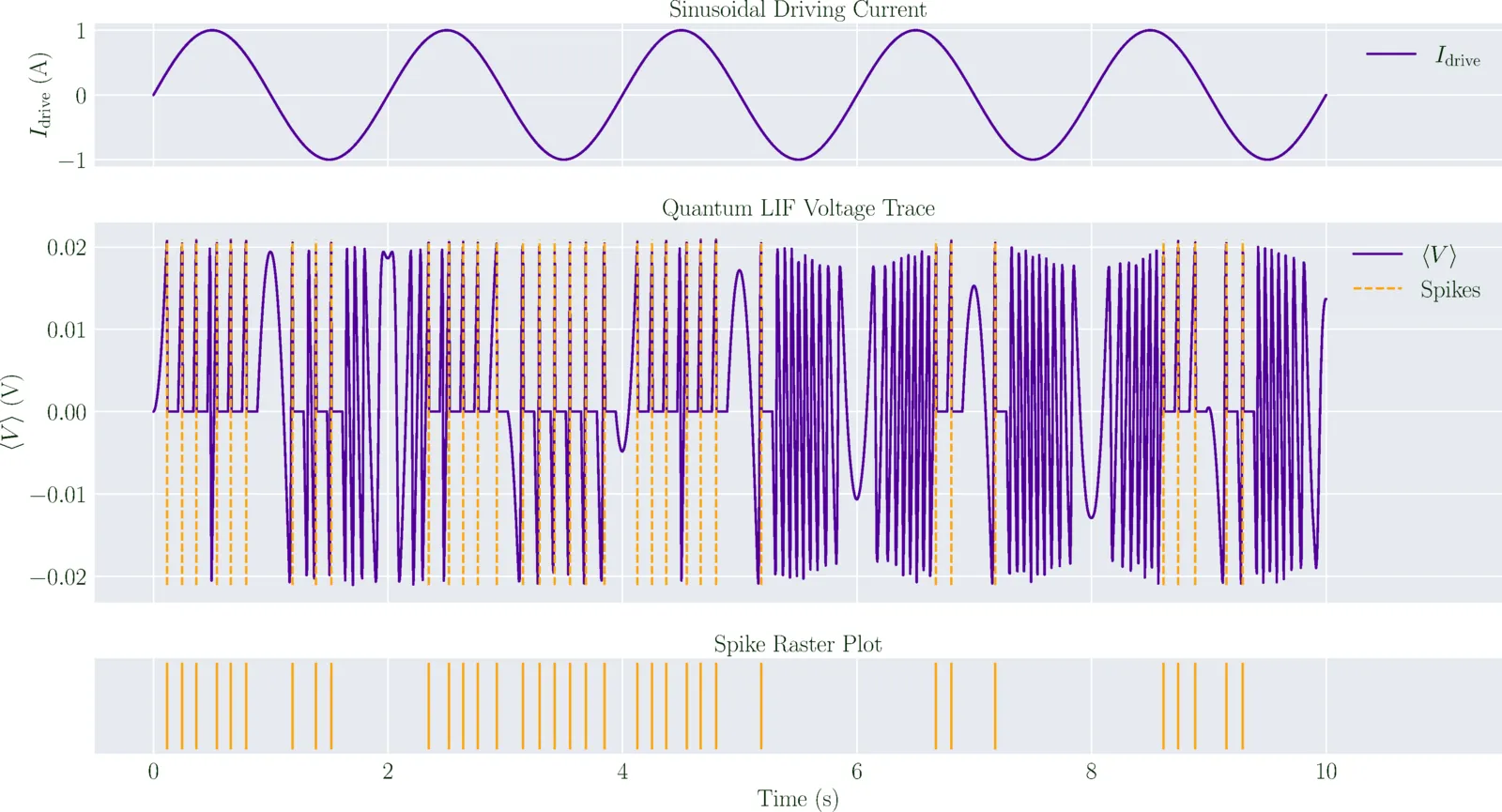
The neuron integrates when the current is positive and is held back when it is negative, which is the excitatory and inhibitory behaviour a biological model should have. The bursts of spikes are not all alike. When the drive is too weak to reach the threshold, the voltage swings without firing while the memristor damps it, and the spikes return when the current turns round.
A first task: where did that sound come from?
You can tell where a sound is coming from with your eyes shut, because it reaches one ear a fraction of a second before the other. In 1948 Lloyd Jeffress proposed how the brain measures that gap. Signals from the two ears run towards each other along a row of neurons, each of which fires hardest when the two signals reach it together. Which neuron fires most tells you the delay, and so the direction.
This makes a clean test for a spiking neuron, because the answer lies in timing alone. We gave the row two sine waves, shifted in phase to stand for the delay, and asked it to recover the phase. We ran it with three kinds of neuron: the one derived here, the designed quantum neuron from the earlier paper, and a classical one.
The derived neuron is close to perfect. Its answers stay within a few degrees all the way round the circle, where the other two wander by twenty or thirty. Why it does so well is not yet settled. Its spike counts change in clean steps as the delay changes, where the other two are noisy, and a clean peak is easier to find.
What it does not show
- The task is a toy. It was chosen because it is simple and well understood, and it says little about harder problems.
- Nothing was trained. How well this neuron learns is the next question.
- The threshold is watched from outside and the reset is imposed. A real neuron does both for itself, and a fully quantum one should too.
- The input current is classical.
- Everything here is in the limit of weak coupling and slow change, which is the limit in which the circuit behaves classically. That is what makes the check possible, and it is also where the least quantum behaviour is to be expected.
- These are numerical simulations. No circuit has been built.
Where it leads
The derivation is written in the language of circuits, which is the language of superconducting quantum hardware, so building one is the natural next step. Beyond that are networks of these neurons, and the question of what memory of this kind is good for in a quantum circuit.
The simulations use QuTiP, and the code is on GitHub and archived on Zenodo.